What To Know
- Ozone is not a substitute for addressing affected material.
- A changed smell does not verify hidden-area treatment.
- Ask about access, moisture, drying, and replacement decisions.
In This Article
What EPA Says About Ozone And Mold
EPA reports that ozone at concentrations within public-health limits does not effectively remove mold and other biological pollutants from indoor air. It also notes that contaminants embedded in porous material may remain unaffected even at high concentrations. Read the EPA assessment of ozone generators for the underlying guidance.
This is general indoor-air evidence, not a test of every car or a vehicle treatment certification. It does, however, undermine the assumption that placing an ozone machine in a cabin establishes complete remediation. Ask what happens to the affected interior itself.
An Air Treatment Does Not Open The Floor
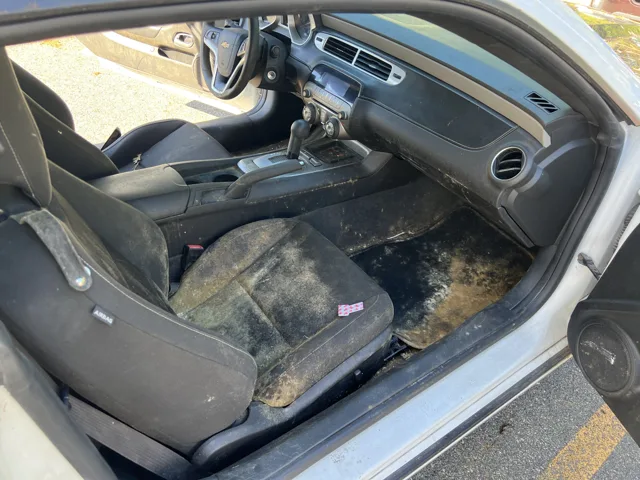
A car can have a problem below a visible surface. Access may be needed to inspect carpet backing, padding, seat mounting areas, and other concealed zones. An air treatment does not make those layers visible or determine whether they can be retained.
Our guide to mold under car carpet explains why the location of growth changes the assessment. The proposal should identify what is inspected, what is physically cleaned, and what needs a replacement decision. A machine name cannot supply those missing details.
It Does Not Resolve A Water Problem
If water keeps entering the cabin, a treatment that leaves the source unresolved has not answered the main maintenance question. Likewise, damp padding needs its own assessment and drying or replacement plan. Ozone does not extract that water or fix the leak.
Explain whether the floor becomes wet after rain, whether a spill occurred, and how long the car sat damp. Our interior water-damage cleanup service separates those physical tasks from an odor-focused conversation. If water is returning, the next question is where it comes from.
A Different Smell Is Not A Treatment Record
Odor matters to the owner, but it is only one observation. A changed smell cannot tell you whether a seat cushion, carpet layer, or hidden floor area was assessed. Ask for an explanation of the work rather than accepting odor as evidence that every affected material is addressed.
If a smell returns, describe the timing and any dampness instead of assuming another air treatment is the answer. Our guide to recurring car mold explains the questions to revisit. What changed physically, and what condition may still be feeding the problem?
Ozone Also Requires An Exposure Discussion
EPA warns that breathing ozone can harm the lungs and that ozone generators can produce excessive concentrations even when instructions are followed. Its guidance is not to use ozone generators in occupied spaces. A car is also a confined space, so do not use a household machine as an improvised treatment while people or pets are inside.
This article does not provide a runtime, concentration, or re-entry schedule. Those cannot be established by a generic blog. A provider proposing ozone should explain its role and precautions without presenting it as a substitute for material-focused work.
What A More Useful Proposal Should Explain
Ask about moisture, affected material, access, physical treatment, drying, and replacement. Our professional removal guide explains that discussion. These questions matter regardless of the equipment in the quote.
CarMold Boston primarily offers mobile assessment and suitable treatment in Boston and Greater Boston. Separate In-Shop Deep Remediation is multi-day work in Pembroke, MA. The setting is chosen around the interior's needs, rather than a promise that one machine handles every car.
Common Questions
Does Ozone Dry Wet Carpet Or Padding?
No. Wet materials need a separate assessment and drying or replacement plan. An ozone generator is not water-extraction or drying equipment.
Does A Better Smell Mean The Mold Is Gone?
No. Smell does not verify the condition of hidden material. Ask what areas were accessed and what physical treatment or replacement work was completed.
Is An EPA Establishment Number Proof Of Approval?
No. EPA explains that an establishment number identifies a manufacturing facility and does not show that EPA endorses a device or finds it safe and effective.
Sources And Further Reading
General indoor mold guidance informs moisture and material principles. Vehicle-specific documents apply to the models they identify; inspection determines what applies to your car.